

Why Learning Piano Builds the Strongest Musical Foundation for Children
- Dr. Tarina Kim

- Dec 12, 2025
- 4 min read

If you’re a parent looking to give your child a strong start in music, few instruments offer as many benefits as the piano. Beyond producing beautiful melodies, piano lessons develop foundational skills that support mastery of virtually any other instrument. From note reading to hand-eye coordination, aural skills, fine motor development, and music theory, the piano is uniquely positioned to set students on a lifelong path of musical success.
For families in the San Fernando Valley, enrolling your child in piano lessons at a reputable academy like MozArt Music Academy can transform not just their musical ability, but also cognitive, emotional, and social skills. With evidence-backed approaches and a supportive learning environment, piano instruction provides benefits far beyond the keys themselves.
1. Piano Lessons Strengthen Note Reading and Musical Literacy

One of the primary advantages of learning piano is its ability to reinforce music reading skills. Unlike instruments where pitch and note production are less visually obvious, the piano presents a clear, linear arrangement of notes, making it easier for children to understand music theory concepts.
Students learn to:
Recognize note positions on both treble and bass clefs
Understand intervals and pitch relationships
Translate written music into accurate sound production
Studies show that children who study piano regularly demonstrate improved visual-auditory integration and enhanced ability to read and interpret musical notation, which translates into better performance on other instruments (Schellenberg, 2004).
2. Fine Motor Skills and Hand Independence
Piano playing requires precise coordination between both hands, often performing different movements simultaneously. This develops fine motor skills, finger independence, and strength, all of which are critical for other instruments like guitar, violin, and wind instruments.
A 2013 study published in Frontiers in Psychology found that children who engaged in regular piano training showed significant improvement in fine motor skills compared to peers who did not receive musical training. These skills also enhance general coordination, making activities such as typing, sports, and handwriting easier.
3. Aural Skills and Ear Training
Playing piano naturally develops a child’s ear for music, as they must constantly match their hand movement with the pitch they expect to hear. Early training on piano has been linked to improved auditory processing, pitch recognition, and melodic memory.
According to research from Northwestern University, early music training strengthens auditory pathways in the brain, improving skills such as sound discrimination, working memory, and speech perception. This makes piano students better listeners and prepares them for ensemble playing, singing, and learning additional instruments.
4. Hand-Eye Coordination and Multi-sensory Integration

Piano lessons engage multiple senses simultaneously: visual (sheet music), auditory (listening to tones), and tactile (finger movement). This multi-sensory learning improves hand-eye coordination and cognitive flexibility.
Children who practice piano regularly have been shown to exhibit faster reaction times and stronger neural connectivity between motor and sensory areas of the brain (Hyde et al., 2009). These cognitive advantages support not only music performance but also academic achievement in math, reading, and problem-solving.
5. Music Theory Becomes Tangible
Unlike some instruments where theoretical knowledge can feel abstract, piano allows children to see and hear music theory in action. Scales, chord progressions, intervals, and harmonies are immediately visible on the keyboard.
This hands-on understanding reinforces concepts like:
Key signatures and modes
Harmonization and chord building
Rhythmic patterns and meter
When children grasp these fundamentals early, they can transition seamlessly to instruments like guitar, violin, or woodwinds, as they already understand how music works conceptually (Hallam, 2010).
6. Cognitive and Emotional Benefits
Beyond musical skills, piano lessons foster:
Executive function (planning, attention, multitasking)
Memory enhancement
Discipline and perseverance
Emotional regulation and self-expression
Studies have shown that children who study piano demonstrate increased IQ scores, verbal memory, and reading comprehension compared to peers without music training. Music becomes an emotional outlet, helping children channel feelings, reduce stress, and build confidence; skills that extend far beyond the studio.
7. A Strong Foundation for Learning Other Instruments
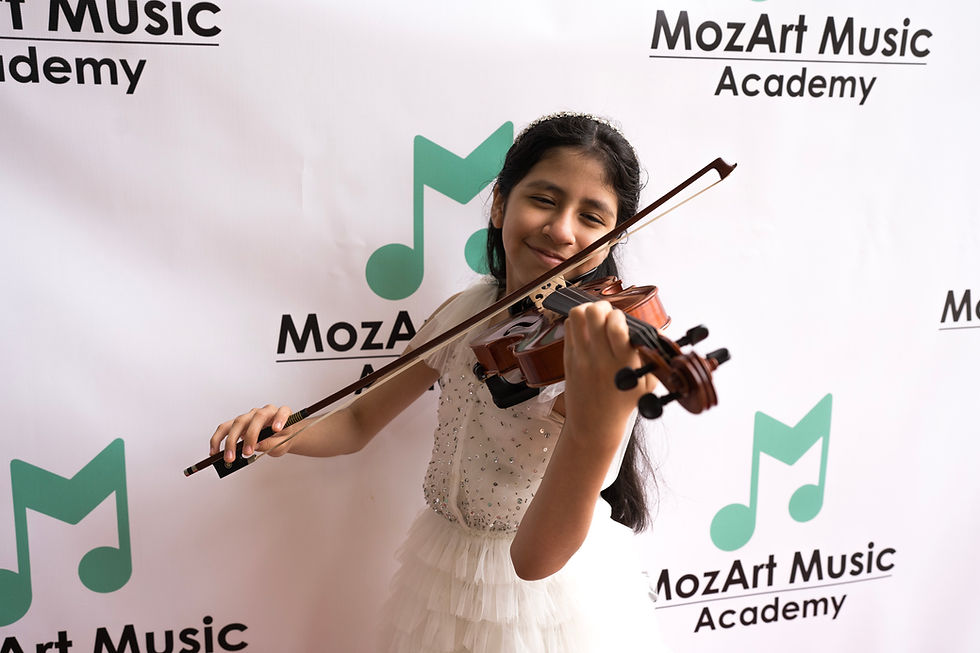
Perhaps the most compelling reason to start with piano is its transferable skills. Once a student has mastered piano fundamentals, learning other instruments becomes significantly easier.
Piano-trained students typically excel in:
String instruments (violin, cello, guitar)
Wind instruments (flute, clarinet, trumpet)
Vocal performance and choir
Composition and songwriting
The combination of note reading, finger independence, rhythm, and theory provides a head start that sets children apart in any musical endeavor (Costa-Giomi, 2013).
8. Why MozArt Music Academy Is Ideal for San Fernando Valley Families
At MozArt Music Academy, we combine research-backed teaching methods with a nurturing environment tailored to each child’s learning style. Families choose MozArt because we offer:
Expert instructors trained in child development and music pedagogy
Top-of-the-line Yamaha acoustic pianos in every lesson room for optimal sound quality
Personalized curriculum for beginner through advanced students
Performance opportunities in recitals and community events
Support for exams such as Certificate of Merit®
Local parents in Tarzana, Woodland Hills, Encino, Calabasas, Sherman Oaks, and surrounding areas trust MozArt for its combination of educational rigor, encouragement, and joy in learning.
9. Practical Tips for Parents
To maximize the benefits of piano lessons:
Start early, but stay flexible: Ages 5–7 are ideal, but older beginners benefit too.
Encourage daily practice: Short, consistent sessions (15–30 minutes) work better than occasional long sessions.
Provide a supportive environment: Celebrate progress, not perfection.
Explore other instruments later: Piano builds the skills necessary for future musical adventures.
These simple steps help children develop confidence and a sense of accomplishment.
10. Conclusion: Start a Musical Journey in 2026
For families planning for 2026 enrichment programs, piano lessons offer a research-backed, educational, and emotionally rewarding experience. Children who study piano gain:
Cognitive, motor, and aural skills
Music literacy and theory knowledge
Emotional resilience and confidence
A strong foundation for learning any other instrument

Investing in piano lessons today is an investment in your child’s lifelong musical and personal growth. At MozArt Music Academy, we specialize in creating personalized, joyful learning experiences that set children up for success, both musically and academically.
Give your child the gift of music, and watch them flourish in 2026 and beyond.
Start by scheduling a free trial lesson with us today!


Comments